What 290 People Told Us About Moving to Nova Scotia
Five years ago, we packed up a family of four and moved to Nova Scotia. I won't pretend it was a perfectly planned decision.
It was 2020. We were locked down on a small lot in Minto Township, Ontario, a town we had only moved to a year earlier after losing out on a more rural property we really wanted. Town wasn't really our thing, but as a homeschool family, the access felt exciting at first. Walking to dance and karate, the movie theatre, local cafes, good parks. Minto is pretty great, honestly. We knew it wasn't forever, but we figured we'd be there longer than a year.
Then the world closed. Watching my kids lose access to everything we had moved there for, while we sat on a postage stamp of land, made something shift. The sight of a Costco parking lot barricaded at the entrance genuinely frightened me. We wanted space. We wanted to grow food, keep animals, let the kids run on land that was actually ours to use. We wanted out.
The pandemic didn't create the dream, it was always kind of there. We talked about it often and looked at viewpoint more than once in the previous years. I even connected with online Nova Scotia homeschooling groups. But the pandemic made staying put feel impossible. We were scared. There were real conversations happening about food supply, about restrictions, about what normal was going to look like. We felt trapped. So we moved, faster than we probably should have, with as much research as you could reasonably do online in 2020. I had never seen the ocean. I had never been to Nova Scotia. But we were up for the adventure if it meant the property and the life we were chasing.
We're still here. We had another baby here, which makes us a family of five now.
And to be honest, I'm not sure I would do it again. I never filled out the form.
This place changed us in ways I didn't expect. It made us realize how much we need family around. It made us realize you don't need as much land as you think to farm. It made us realize that belonging somewhere is its own kind of resource and it's one you can't buy or research your way into.
Do I dislike it here? Not at all. I built this community because I needed to connect with other people who understood the transition. We tend to find each other, as a friend put it recently. There's a real kinship among people who made the same leap and that's meant something to me.
But somewhere in the middle of all of it, I started wondering what the numbers actually say. Not the highlight reels. Not the doom posts. What do real people, who have actually done this, actually think?
So I started asking.
A Simple Question, Asked 290 Times
Where did you come from, where did you land, and would you do it again?
No long survey. No demographic deep-dive. Just those three things, collected one response at a time from real people who had made the move.
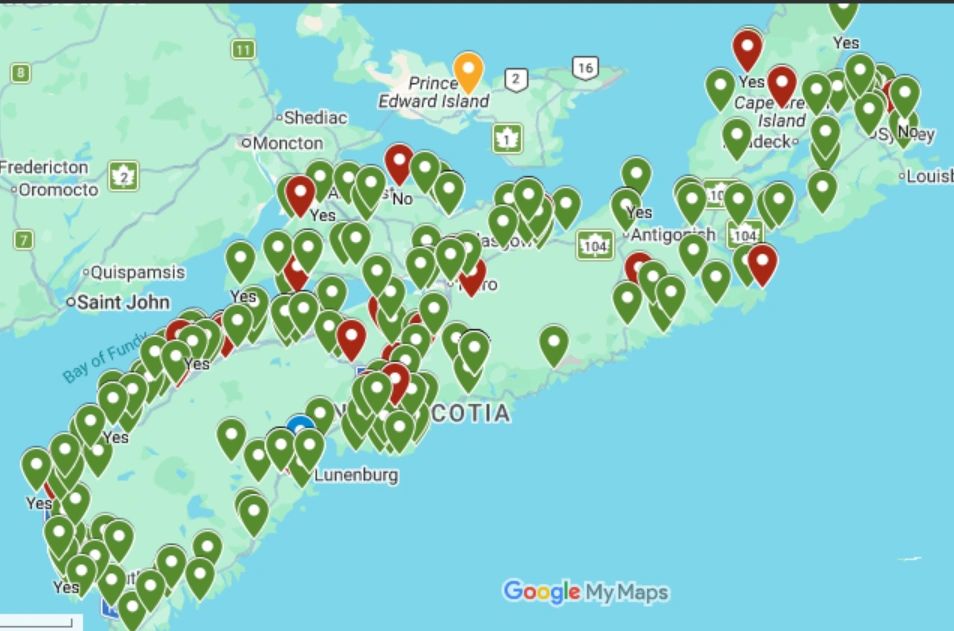
We now have 290 answers. Here's what they say:
Most People Come From Ontario. By a Lot.
64% of respondents moved from Ontario. Ottawa leads the list, followed by Toronto, Hamilton, Barrie, and London. BC and Alberta account for most of the rest, with a small number coming from Quebec and the United States.
This isn't surprising to anyone who has spent time in the community but seeing it in the data confirms something worth saying plainly: the Nova Scotia relocation story right now is largely an Ontario story. The housing math, the cultural adjustment, the expectations about pace of life, the shock of a different winter... almost all of it maps back to what it means to leave a large Ontario city and arrive somewhere that operates completely differently.
If you're from Ontario and you feel like everyone around you made the same move, you're not imagining it.
2021 Was the Peak. But 2025 Came Close.
The highest single year in the dataset is 2021, with 47 respondents. 2022 follows closely at 45. Then a noticeable dip through 2023 and 2024 as the post-pandemic urgency settled and housing prices in Nova Scotia rose enough to change the math for some buyers.
What's interesting is 2025. It's right back up at 44 responses, nearly matching the 2021 peak. The move is still happening. The wave didn't crash, it paused and restarted.
2026 already has 15 responses and we're only a few months in.
85% Say They Would Choose It Again.
Across all 290 responses, 85% of people said yes, they would make the same move again.
That number has held remarkably consistent as the dataset has grown. It's not a marketing claim. It comes from a form anyone can fill out, including people who regret it, and 15% of them did say no. From 50 answers to 300, it was always this split. I found that so interesting.
The regional breakdown is close across the province. Northumberland Shore sits at 88%. The Annapolis Valley at 86%. HRM at 85%. Cape Breton at 83%. South Shore at 81%. SW Nova Scotia at 79%.
No region is dramatically worse than another. But the communities at the lower end tend to be the more remote ones, which tracks with what we hear consistently: the people who struggle most are often the ones who underestimated how much isolation and distance from services would affect daily life.
What the Data Doesn't Capture
A number is not a story.
85% satisfaction sounds clean and reassuring. But the 15% who said no weren't randomly unlucky. When you dig into what the community shares about regret, a pattern shows up consistently: it's not usually the practical stuff that breaks people. It's the feeling of never quite belonging. Of being welcomed on the surface but not folded in. Of building a life in a place that doesn't fully feel like theirs yet and wondering if it ever will.
Integration is harder to research than internet speeds. You can confirm a download rate before you sign a lease. You can't confirm whether you'll find your people, whether the community will open up or whether you'll still feel like an outsider two years in.
That's not a reason not to move. But it's worth being honest with yourself about how much community and belonging matter to you before you go, because Nova Scotia can be genuinely isolating if you arrive without a plan for building connection.
Your Data Point Matters
290 responses is enough to see patterns. 500 would be enough to say something credible at a provincial level. 1,000 would be something no one else in this space has.
If you've made the move and haven't added your response yet, it takes about two minutes. Where you came from, what year, where you landed, and whether you'd do it again.
That's it. Anonymous. No follow-up.
And if you haven't moved yet but you're deep in the research phase, the map is worth spending time with. It shows you where people from your city or region have actually landed, and how they feel about it.
The more people who add their data, the more useful it becomes for everyone who comes after them.